




Updated: February 2026
TL;DR: For most Canadian students in Grades 1–2, a practical backpack size is 10–13 L (Grade 1) and 12–15 L (Grade 2). To fit classroom cubbies, keep the packed profile ≤ 28 cm width and ≤ 13–15 cm depth, and make sure it holds a rigid 8.5×11" duotang flat (no corner curl).
Most common cubby jam: side bottle pockets add 2–3 cm to total width when packed. If your bag “should fit” but still sticks, it’s usually the bottle pocket.
Scope: Everyday school backpacks for Canada (not hiking/travel). · See the full Backpack Size by Grade hub.
Backpack size for Grade 1–2 (Canada): quick table
Tip (mobile): swipe the table left/right →
| Grade | Recommended volume (L) | Packed profile (pass/fail) | What it must fit | Canada-specific cubby reality |
|---|---|---|---|---|
| Grade 1 | 10–13 L |
Width: ≤ 28 cm Depth: ≤ 13 cm (incl. bottle pocket if used) |
Rigid 8.5×11" duotang (flat), lunch kit (often inside), 500 ml bottle, pencil case, light layers | Many Grade 1 cubbies are ≈ 29 cm / 11.5" wide. Depth failures cause bags to stick out and get stepped on. |
| Grade 2 | 12–15 L |
Width: ≤ 28 cm Depth: ≤ 15 cm (incl. bottle pocket if used) |
Thicker notebooks + duotang, lunch kit (inside), 500–750 ml bottle, sweater/mittens (seasonal) | Rigid/molded panels + deep pockets are the #1 reason Grade 2 bags jam and fall off hooks. |
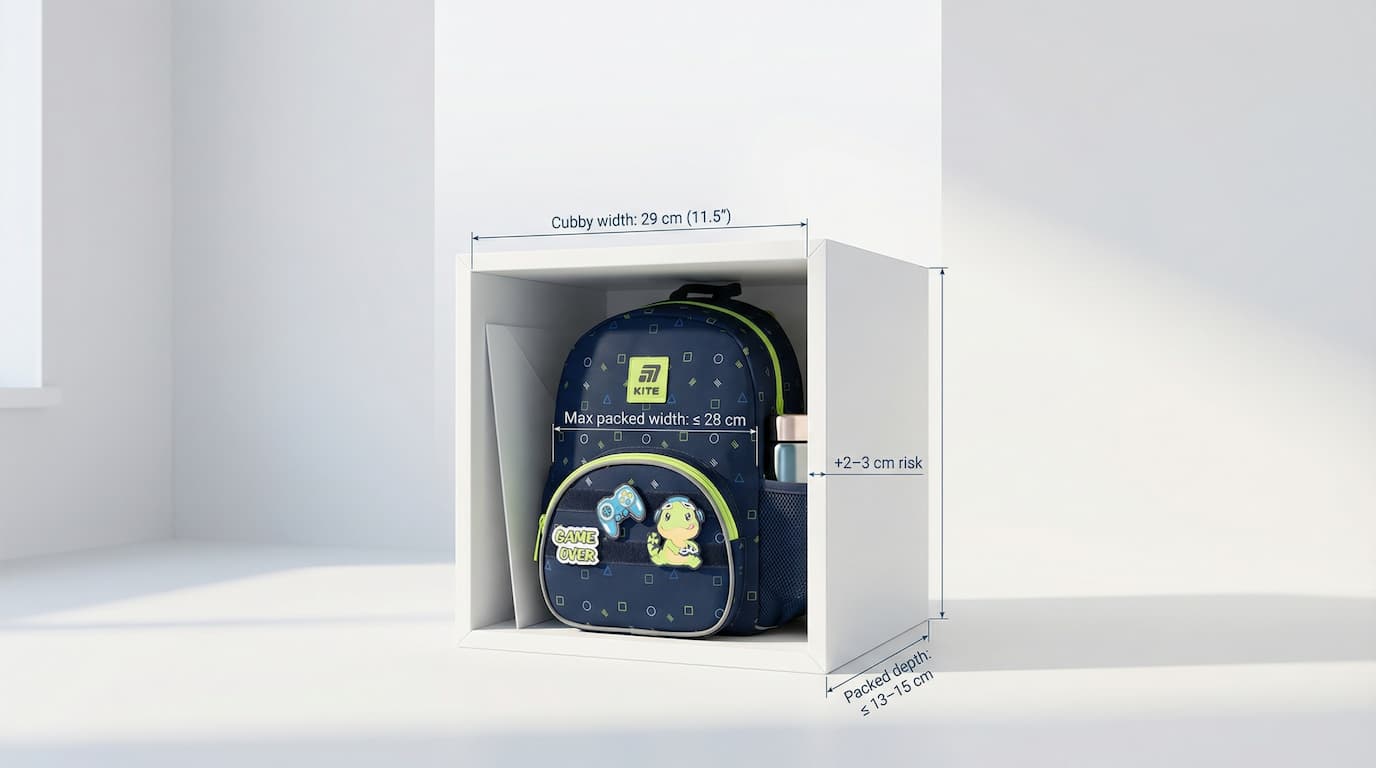
Pro tip: cubbies usually fail on width (incl. bottle) and packed depth, not “liters”.
How to choose the right size (Grade 1–2)
Step 1: Start with liters (then verify cubby profile)
Use 10–13 L for Grade 1 and 12–15 L for Grade 2 as your default. Then verify the packed profile: the bag should stay ≤ 28 cm wide and ≤ 13–15 cm deep when full.
Step 2: The Canadian cubby rule (29 cm / 11.5")
Many Grade 1–2 classrooms use cubbies that are about 29 cm (11.5") wide. Aim for a backpack that compresses under that width — ideally ≤ 28 cm packed — so it hangs properly and doesn’t stick into walkways.
Step 3: Duotang test (no-curl corner guarantee)
Grade 1–2 bags must hold a rigid 8.5×11" duotang flat. If the corners bend or curl, the backpack is a FAIL for Grade 1, even if the liters look “correct”.
Step 4: Winter strap reality (sternum strap is not optional)
In Canadian winters, shoulder straps slide on low-friction nylon parkas. A sternum (chest) strap keeps the backpack stable for small frames and reduces “one-strap carry”.
Ergonomic fit guidelines (Grades 1–2)
- Compact carry: the backpack should sit higher and closer to the back (not low and loose).
- Fit control: adjust shoulder straps + use a chest strap to prevent sliding on winter layers.
- Heavier items closer to the back: keeps the load stable and reduces backward pull.
- Empty weight target: aim for an empty backpack around ≤ 900 g for Grade 1; ≤ 1 kg for Grade 2.
- Daily load benchmark: many families reference about 10–15% of body weight as a practical limit (general guidance, not medical advice).
Canada factors (cubbies, winter layers, lunch-inside)
- Lunch-inside reality: in Grades 1–2, many kids carry lunch kits inside their backpack to keep hands free for boots/snow pants. This is why ultra-small bags often fail in real routines.
- Metal bottles: if you use a heavier bottle, prioritize a pocket with good elasticity and a snug fit so it doesn’t widen the bag or snag cubby walls.
- Soft-shell beats rigid: molded fronts and rigid shells don’t “squish” into shared spaces and are more likely to crack or jam.
- Tech policy changes: as of 2026, most Grade 1–2 classrooms do not require laptop compartments. If your school issues devices, keep the 28 cm width and depth limits anyway.
Quick “measure at home” cubby test
Pack the backpack like a school day (duotang + lunch + bottle). Then measure: width (including bottle pocket) and depth when packed. If width exceeds 28 cm or depth exceeds 15 cm, it will likely jam or stick out of many Grade 1–2 cubbies.
Navigation: If you’re shopping after sizing, browse compact elementary backpacks and compare by grade. The guidance above stays universal.
- Full overview table: Backpack Size by Grade (Canada)
- Shop (kids): Browse backpacks
- Next size up: Grade 3–5 backpack size
- Older students: Grade 9 backpack size (lockers + laptops)
Note: This guide offers general sizing information for everyday school use and is not medical advice.
FAQ
Is 17 liters too big for Grade 1?
Often yes. 15–17 L can work only if the backpack is soft-shell, compressible, and stays under 28 cm packed width (including bottle pocket) with ≤ 13–15 cm depth.
Can I use a preschool backpack for Grade 1 in Canada?
Usually no. Preschool bags (often 6–10 L) typically can’t hold a rigid 8.5×11" duotang flat and don’t handle lunch-inside routines.
How do I check cubby fit at home?
Pack the bag like a real day, then measure width (incl. bottle) and depth. If it’s over 28 cm wide or deeper than 15 cm, it will likely jam in many cubbies.
Do Grade 1–2 students need a laptop compartment?
Typically no. As of 2026, most Canadian Grade 1–2 classrooms do not require laptop carry. If your school issues devices, prioritize the same cubby profile limits.
What if my child is very small or tall for their grade?
Adjust capacity by ±1–2 L if needed, but keep the cubby constraints: ≤ 28 cm packed width and ≤ 13–15 cm depth.
Continue: Backpack Size by Grade hub · Grade 3–5 · Orthopedic vs Regular · Elementary backpacks